
THE DISCIPLINE
A lens. A way to untangle messy situations. They can feel stressful and uncertain, but they’re an invitation to put on your detective badge and follow the clues. The clues—and the connections—are everywhere.
Messy situations at a corporate or personal level have a lot in common. The differences are scale, magnitude, finances, the number of people involved, and the number of touch points. But when it comes to untangling a messy situation, the process is surprisingly similar.

PEOPLE USUALLY START WITH A PROBLEM.
I LIKE TO START WITH THE PROOF OF THE PROBLEM.
What is causing the problem?
Is the problem a symptom of a cause that still hasn’t been identified?
Is it people's understanding?
Is it the shared understanding?
Is it the handoff process?
Is it the process itself?
I call this orienting myself to the problem.
SHOW ME WHAT HAPPENS.
not what the process document says happens.
The fastest way I’ve found to do that is to walk through the process.
Once I understand the situation, that’s when my
INSPECTOR GADGET
gadgets come out.
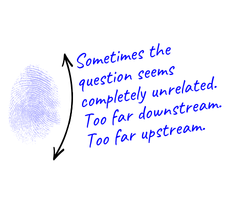
BUT THEY CONNECT AT ONE POINT.
LET
CURIOSITY
LEAD
Curiosity has some unexpected side effects.
- I learn the system gossip.
- I learn how different people see the same problem.
- I see how the work actually gets done—not how we think it gets done.
- I start noticing where the friction lives.
- I discover opportunities to improve the process.
- I usually build relationships across departments because if there’s a hiccup in one area, someone else is almost always paying for it somewhere else.
SO WHERE IS THE DISCIPLINE?
It’s in following the threads long enough for the picture to emerge.
But we don’t do boring here.
You’ll have to explore the Studio
for clues until the book is ready.
Curious how Clarity Architecture applies to you?
Want to see what this look like in practice?

Have a messy situation?
NOTES TO YOUR INBOX
New observations, ideas, and stories—straight to you.
notes,
not noise.
hello@gaudicia.studio
LinkedIn: @gaudicia
Copyright © 2026 Gaudicia Studio, LLC
All rights reserved. Privacy Policy | Terms and Conditions